
Morocco is magic. Simply magic. If you are a first-time traveller and trying to explore the north of Africa, I highly recommend putting this country on top of your bucket list. It is also one of the most photogenic places I have ever been to. Colourful, magical and breathtaking.
The Sahara Desert in the east, the Blue City of Chefchaouen in the north, the Atlas Mountains of the south and wondrous cities like Marrakech and Casablanca lighting up the centre and the west. With so much to offer, it does become hard to choose where to go. But hopefully my itinerary might help induce some inspiration.
Travel itinerary
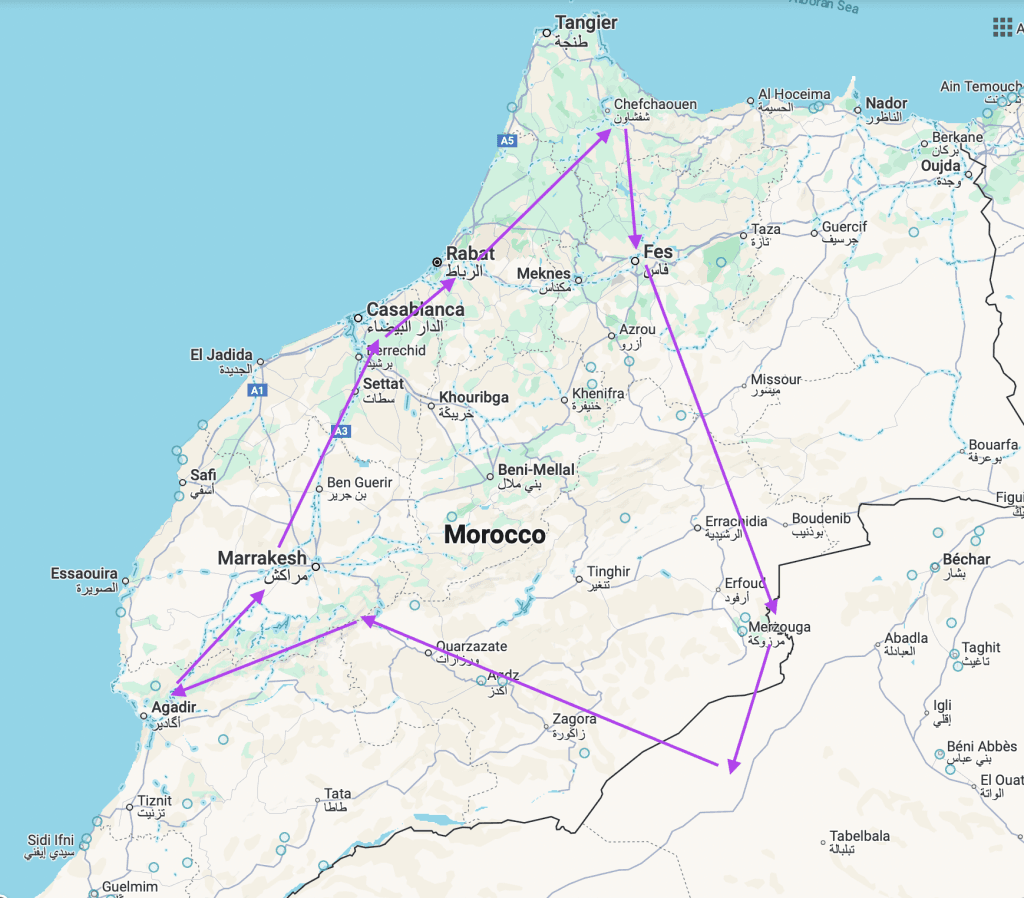
2 days: Rabat
3 days: Chefchaouen
2 days: Fez/Fez
1 night: Merzouga
1 night: Sahara Desert
1 night: Atlas Mountains
3 days: Marrakech
2 days: Casablanca
1 night: Rabat
History
Dating all the way back to the 10th Century, Morocco was inhabited by predominantly indigenous Berbers, North African tribes that ruled since prehistoric times. What followed was a series of colonisations and invasions during the 8th – 6th Century BCE, all the while the hinterland remained under control of indigenous monarchs. These Berber kingdoms ruled from the 3rd Century BCE until 40 CE when it was conquered and added to the Roman Empire. This was Morocco’s first experience with Christianity.
During the mid-5th century CE, the Germanic Vandals invaded the country before it was officially annexed to the Byzantine Empire during the 6th Century CE.
Early 8th Century Muslims invaded the region for the first time but were interrupted by the Berber Revolt. This forced the separation of the Umayyad Caliphate -a monarchical governmental model based on the succession of the Islamic State.
A couple of decades later, the official Moroccan state was established by the Idrisid Dynasty and with this established the first Islamic dynasty in Morocco. The Saadi dynasty took over and ruled from 1549 – 1659. And in present-day Morocco the Alawis dynasty rules and has been doing so since 1667.
Morocco became a French Protectorate in 1912 but broke free in 1956 and became independent.
Is it safe to travel to Morocco?
Yes, it is. Morocco is also safe place to travel to as a female solo traveller. However, there is always a need to act with caution. Especially, when you travel alone. Common practices are pickpockets and scams can occur so, remain vigilant and I always say “trust you instinct”. When something doesn’t feel normal or right, it probably isn’t.
Do’s and dont’s for solo travel in Morocco
- Refrain from any display of affection in public. If you travel as a couple or pick up a holiday lover, don’t do it. It is not acceptable behaviour in Morocco and will be frowned upon, and sometimes even addressed.
- Don’t dress up exposing too much skin. Especially for women it’s best to bring trousers or skirts that aren’t shorter than your knees. And bring shirts that cover up at least the shoulders. Try to avoid ripped jeans, cleavage or see-through shirts. It’s not mandatory to go full conservative style like the locals, but you will be looked at and frowned upon. Note: if you go into any places of religion, like mosques it is mandatory to cover up, including wearing a headscarf or at least not leave your hair out. You will be asked to take your shoes off as well, so bring socks if you plan on going into a mosque. These hidden rules are more flexible in the cities like Marrakech or Casablanca, however, still be on the safe side and respectful of their local culture and customs.
Rabat
What to do in Rabat?
Hassan Tower is definitely a must-see! This is the famous unfinished minaret that was supposed to become the biggest mosque in the world. It was left at 44 meters high, surrounded by 348 equally unfinished columns. Abu Yusuf Yaqub al-Mansur had ambitious plans for this mosque. However, the construction seized after he passed away. The remains of the tower, along with the Mausoleum of Mohamed V are definitely worth visiting and one of the best tourist highlights of the city.
Is it safe?
Yes, Rabat is one of the safest places in Morocco. I always say, to act with caution when travelling alone and not push your luck or be the tough guy/girl while you’re not in your own country. It is best to avoid the dark alleys at night. And try not to use ATM machines in these particular areas.
How to get around?
Rabat has several ways of getting around the city.
- Petit taxis: affordable and easily accessible. You can flag them down or find them at the busy hotspots like stations and parking lots. They go at a minimum rate of DH5. To go anywhere in the city, it won’t cost more than DH30.
Where to stay?
Luxury hotels:
Hotels